

Dental Burs
1.DENTAL BURS
Dental burs have played a crucial role in pushing dentistry forward by being essential instruments for cutting tough tissues like bone or teeth. They are usually made of stainless steel, diamond particles, or tungsten carbide, and attached to a dental drill powered by an air turbine. Invented three centuries ago, dental burs are still extensively used today. They consist of three key components: the head, neck, and shank.

Figure 1. Various parts of Dental Burs
Burs come in different shapes and sizes, each designed for specific applications and can rotate at speeds of up to 500,000 revolutions per minute (rpm).
They can be made of steel and coated with a hard material like tungsten carbide, or they can be entirely made of tungsten carbide. These burs are used for various cutting and drilling purposes.
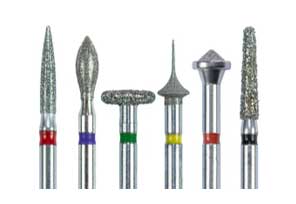
Figure 2. Diamond Dental Burs
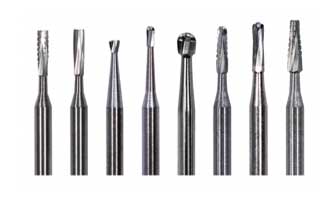
Figure 3. Carbide dental burs
In general, bur geometrical features are typically crafted with a negative rake angle. However, those with a positive rake angle are primarily intended for cutting soft materials such as acrylics, aiming to efficiently remove material during cutting to prevent tool clogging with chips. Steep rake angles on bur blades can potentially harm the tooth’s subsurface, creating vulnerable areas prone to bacterial infection. Decreasing the rake angle results in a gentler action, albeit with a shorter bur lifespan due to the acute angle of the cutting tips. Nevertheless, this adjustment leads to less residual subsurface damage to the tooth.
![Figure 4. (A) The geometry of a typical tungsten carbide bur. (B) Schematic diagram showing the rake angle relative to the cutting direction. [1]](https://cihealthtech.ca/wp-content/uploads/2024/03/figure4.jpg)
Figure 4. (A) The geometry of a typical tungsten carbide bur. (B) Schematic diagram showing the rake angle relative to the cutting direction. [1]
Stainless steel, despite its tendency to wear quickly and corrode easily, can be a preferred choice for burs at lower speeds due to reduced wear rates during cutting. Although it is more prone to corrosion, especially during sterilization, stainless steel offers better corrosion resistance than carbon steel. While it may not provide as efficient a cutting edge as carbon steel, its affordability makes it suitable for single-use disposable burs.
Tungsten carbide (WC) is a highly wear-resistant material, but it is also brittle and expensive. Because of this, only the blades of a bur should be made of tungsten carbide, while the shank can be made of steel. Sintering is used to join the carbide blades onto the steel shank.
Tungsten carbide is also suitable for burs that are used at lower speeds and are meant to be used repeatedly. Cobalt is added as a binder to the WC burs, making up about 6% of the material. This addition provides additional toughness to the tool.
The properties of the material are controlled by two parameters: the Co/WC ratio and the WC particle size. If a high percentage of cobalt is combined with coarse-grained WC, the tool will have better shock resistance and impact strength. However, if the WC particle size is finer, and the percentage of cobalt is lower, the tool will be harder and have greater wear resistance.
To achieve optimum performance, premature failure needs to be avoided, while achieving a higher wear resistance.
Conventional diamond dental burs consist of small diamond particles bonded onto a substrate using a binder matrix material. However, this type of bur has limitations due to the heterogeneity of the grain sizes and shapes, difficulty in automating fabrication, and short tool lifetimes. Repeated sterilization of the instruments also decreases their cutting effectiveness and results in diamond particle loss, which can cause oral contamination.
![Figure 5. SEM micrograph of a conventional sintered diamond bur showing one diamond particle embedded in a binder matrix material. [1]](https://cihealthtech.ca/wp-content/uploads/2024/03/figure5.jpg)
Figure 5. SEM micrograph of a conventional sintered diamond bur showing one diamond particle embedded in a binder matrix material. [1]
Each bur is crafted to function optimally at a specific speed and is tailored for compatibility with particular hand-piece motor combinations. The ideal speed is contingent upon the material being cut. Cutting speed falls into two distinct categories, each utilizing specific burs designed for different tasks.
Low-speed handpieces are powered by miniature compressed air or electric motors, rotating at speeds up to 4000 rpm. Burs employed in low-speed tasks are utilized for tasks such as denture trimming and decayed tissue removal, typically crafted from stainless steel.
High-speed air turbine handpieces can run up to 500,000 rpm, although they are seldom operated at such extremes. Typically, they function within a range of 20,000 to 50,000 rpm, depending on the bur diameter. Burs used at high speeds are predominantly diamond-coated or composed of tungsten carbide, primarily employed for tasks like enamel, dentine, and old filling removal. When operating at such velocities, a built-in water spray serves as a coolant, safeguarding both the bur and the tooth.
Coating the bur with a diamond helps lengthen its working life so that it can be used for multiple patients and can withstand repeated sterilization. However, this process can increase the risk of instrument fracture and also has the potential to be corrosive and affect the cutting surface or coating of the bur. It’s important to note that conditions in the surgery are different from the laboratory.
2.CHEMICAL VAPOR DEPOSITION (CVD) OF DIAMOND FILMS ONTO DENTAL BURS
Dental burs’ lifespan and performance can be enhanced by coating them with diamond films. Diamond is an ideal material for this purpose due to its high hardness, thermal conductivity, chemical inertness, and wear resistance. (Table 1).
![Table 1. Physical Properties of Diamond [2,3,4]](https://cihealthtech.ca/wp-content/uploads/2024/03/table1.jpg)
Table 1. Physical Properties of Diamond [2,3,4]
The success of CVD methods has expanded the potential applications of diamonds, particularly in industries such as automotive, consumer products, defence, and space technology. The most successful CVD process involves using energetically activated hydrocarbon/hydrogen gas mixtures to deposit diamonds. This process involves the formation of a thin solid layer from gaseous reactants through a chemical reaction onto a substrate at high temperatures. A CVD reactor is essential for this process, performing tasks such as transporting gases to the substrate, providing the necessary activation energy to the reactants, maintaining specific pressure and temperature conditions, facilitating film deposition, and removing gaseous by-products. There are several different approaches for activating precursor gases for diamonds, which include the following.
2.1 PLASMA-ENHANCED CVD
Plasma has been used for many years to deposit diamond films through various forms of electrical discharges or inductions heating. The plasma contains atomic hydrogen and other carbon-containing species that are essential for diamond growth. These species are highly energetic and enable diamond films to be deposited at lower substrate temperatures compared to thermal CVD processes. The efficiency of different plasma processes varies from one method to another. Three plasma frequency regimes are commonly used, namely, microwave plasma-enhanced CVD which usually uses excitation frequencies of 2.45 GHz, radiofrequency (RF) plasma excitation which employs frequencies of typically 13.56 MHz, and direct-current (DC) plasmas which can be operated at low electric powers (a “cold” plasma) or at high electric powers (which create an arc or a thermal plasma).
2.1.1 Microwave plasma-enhanced CVD
Microwave plasma-enhanced CVD is the most extensively and successfully used plasma-based method for growing diamond films. Unlike other plasmas, microwave plasmas can oscillate electrons with microwave frequency. This generates a high degree of ionization when electrons collide with gaseous atoms and molecules. Microwave deposition has several advantages over other plasma-based methods of diamond film growth. Since it is an electrodeless process, it prevents contamination of films due to electrode erosion. Furthermore, the 2.45 GHz microwave discharge produces a higher plasma density with higher-energy electrons than the RF, resulting in higher concentrations of atomic hydrogen and other hydrocarbon radicals that produce efficient high-quality diamond films. Moreover, the plasma is confined to the center of the deposition chamber as a ball, which prevents carbon deposition onto the walls of the chamber.
2.1.2 RF plasma-enhanced CVD
In this method, radio frequency (RF) power is used to create a plasma by applying it to two electrodes in either an inductively coupled or a capacitively coupled parallel plate arrangement. The use of inductively coupled RF plasma and capacitively coupled methods for growing diamond crystals and thin films has been widely reported. For efficient diamond growth, a high-power discharge leading to greater electron densities is necessary. However, using higher power can cause physical and chemical sputtering from the reactor walls, which leads to contamination of the diamond films. Although RF plasmas can be generated over much larger areas compared to microwave plasmas, the method is not commonly used for depositing diamond films because the quality of the films produced is inferior.
2.1.3 DC plasma-enhanced CVD
In this method, a mixture of hydrogen and hydrocarbon is excited by applying a DC bias across two parallel plates, with one of them being the substrate. The DC plasma-enhanced CVD method can coat large areas since the diamond deposition area is limited by the electrodes and the DC power supply. This technique has the potential for high growth rates as well. However, diamond films produced by DC plasmas were reported to contain impurities due to plasma erosion of the electrodes and under high stress, as well as high concentrations of hydrogen.
2.2 HOT FILAMENT CVD
The Hot Filament Chemical Vapour Deposition (HFCVD) method offers several advantages compared to other methods mentioned. In this technique, atomic hydrogen is generated by passing H2 over a heated refractory metal filament, such as tungsten, molybdenum, or tantalum, at temperatures ranging from 2000 to 2500 K. Introducing atomic hydrogen into the hydrocarbon, typically with a C/H ratio of 0.01, leads to diamond deposition while suppressing graphite formation. The production of atomic hydrogen in diamond HFCVD facilitates a significant enhancement in the diamond deposition rate, which can be less than 1 μm/h, and nucleation along with the growth of diamond on substrates that are not initially diamond.
Due to the simplicity and relatively low operational costs of HFCVD, this method has become widely utilized in various industries. For the growth of diamond film by HFCVD, a gas mixture of CH4 (0.5%-2.0%)/H2 is used, along with typical deposition parameters where the total pressure ranges from 10 to 50 Torr and the substrate temperature ranges from 1000 to 1400 Kelvin.
A wide variety of refractory materials have been used as filaments, including tungsten, tantalum, and rhenium, due to their high melting point and high electron emissivity.
2.2.1 Growth mechanisms
There are several suggested ways to grow diamonds. At the filament surface, the gas phase establishes thermodynamic near-equilibrium. When the temperature reaches approximately 2300K, molecular hydrogen dissociates into atomic hydrogen. The H atoms can then convert methane into methyl radicals, which are considered the primary diamond precursor species. Afterwards, they transform into acetylenic species and other hydrocarbons, which are stable at these high temperatures. The atomic hydrogen and the neutral and radical hydrocarbon species then move to the substrate surface. Although the gaseous species formed at the filament reach equilibrium at the filament temperature, they are at a super equilibrium concentration when arriving at the significantly cooler substrate. The reactions that produce these high-temperature species close to the filament, where there is a high concentration of hydrogen atoms, proceed faster than any other reactions that decompose these species during the transit time from the filament to the substrate. Consider the equilibrium between methane and acetylene:

The process of diamond synthesis through HFCVD involves the creation of methyl radicals and acetylene at the filament surface, followed by the diffusion of CH3 radicals and other hydrocarbon species to the substrate. Although the equilibrium at the substrate temperature of around 1100K favours the formation of methane, the reverse reaction occurs at a slower pace. To reduce the super-equilibrium concentration of CH3 and other species in the gas phase, solid carbon precipitates on the substrate. Diamond is more stable than graphite due to the concurrent super-equilibrium concentration of atomic hydrogen.
The method utilized in chemical vapour deposition (CVD) to create diamonds relies heavily on hydrogen atoms, which play a vital role in catalyzing the formation of active hydrocarbon molecules. Their presence is crucial for preventing the restructuring of the developing diamond surface and inhibiting the formation of graphitic nuclei. The quality and speed of growth of diamond films are contingent upon the proportion of carbon to hydrogen in the gas mixture used as the precursor. A higher ratio of carbon generally results in accelerated growth rates, but it also yields films of inferior quality due to a shortage of hydrogen, which is essential for removing non-diamond carbon deposits. Conversely, an excessive concentration of hydrogen at the growing surface can lead to the erosion of the diamond, resulting in either no growth or extremely slow growth rates.
![Figure 6. Principle of plasma CVD diamond growth, and (b) the mechanism of surface chemical reaction of CVD diamond growth [5]](https://cihealthtech.ca/wp-content/uploads/2024/03/figure6.jpg)
Figure 6. Principle of plasma CVD diamond growth, and
(b) the mechanism of surface chemical reaction of CVD diamond growth [5]
2.2.2 Filament characteristics
In the HFCVD process, the filament plays a crucial role. Tantalum and tungsten are commonly used filament materials due to their high melting point and electron emissivity. Refractory metals like tungsten and tantalum must carburize their surface before supporting the deposition of diamond films, which means they consume carbon from the hydrocarbon precursor gas. As a result, there is a specific time for the nucleation process, which affects the early stages of film growth. However, it does not affect the quality of the resulting films over longer growth periods. The incorporation of carbon causes cracks along the length of the wire. These cracks are undesirable as they reduce the lifetime of the filament but do not affect the film quality. Suitable filament materials must also have appreciable electron emissivity to cause the dissociation of molecular hydrogen and initiate the growth process. Tungsten and tantalum filaments are typically used in HFCVD processes because of their high melting point and electron emissivity. Ta filaments are used as they cause less contamination of the diamond films than W filaments. The physical and chemical properties of filament materials directly affect gas activation and decomposition, which may affect diamond deposition under otherwise constant parameters.
![Table 3. Selected physical data for prospective filament materials [6]](https://cihealthtech.ca/wp-content/uploads/2024/03/table3.jpg)
Table 3. Selected physical data for prospective filament materials [6]
The first step in this process involves the transfer of CH4 from the gas phase to the metal surface, where it undergoes physical adsorption. During the next step, CH4 decomposes on the metal surface, resulting in the chemisorption of carbon and hydrogen atoms. This leads to the liberation of gaseous H, H2, and CHX. In the subsequent step, the adsorbed carbon atoms are transformed into the dissolved state. Finally, these carbon atoms diffuse into the metal lattice to form sub carbides (M2C) and carbides (MC).
In case the temperature of the filament drops below a critical point, a layer of carbon forms on the filament, depending on the amount of carbon present. This carbon layer hinders the filament surface’s activity, which causes a decrease in temperature and a rapid reduction in the production of atomic hydrogen. To prevent this from happening, the power supplied to the filament should be promptly increased to remove or vaporize the carbon layer. Otherwise, the carbon layer will continue to thicken, further lowering the filament temperature.
A filament operates most effectively when its surface is completely free of carbon. Any changes in filament emissivity, resistance, and power consumption are linked to the deposition and removal of carbon on the surface.
2.2.3 Diamond nucleation process
The initial stage of diamond nucleation on a non-diamond substrate is a critical and complex process, particularly when considering its application to dental burs. The process involves promoting the nucleation of diamond crystals onto the substrate surface and reducing the induction time, which can significantly affect the adhesion, growth, uniformity, and morphology of the diamond films deposited by CVD.
To achieve this, several methods have been used for many years, including traditional methods such as using diamond powder or immersing in diamond paste with small crystals in an ultrasonic bath have long been employed to facilitate diamond film deposition. These methods stimulate diamond crystal formation on the surface by creating numerous nucleation sites, thus reducing the time required for the process. Mechanically, this can be achieved by polishing the substrate with abrasive grit, typically using diamond powder with particle sizes ranging from 0.1 to 10 μm.
In contrast, bias-enhanced nucleation, offers more control over the growth of heteroepitaxial diamond films compared to mechanical abrasion. In this approach, the substrate is negatively biased relative to the filament, generating an intense plasma due to the diamond’s negative electron affinity. This process leads to the creation of nucleation sites on the substrate through electron emission and ion bombardment, promoting diamond growth. Moreover, increasing the bias voltage results in smaller crystal sizes due to heightened ion bombardment before and during the initial growth stages at higher voltages.
References
- Sein, W. Ahmed, C. Rego, Application of diamond coatings onto small dental tools, Diamond Relat. Mater. 11 (2002) 731.
- N. Yoder, in: K.E. Spear, J.P. Dismukes (Eds.), Synthetic Diamond: Emerging
- E. Field, The Properties of Natural and Synthetic Diamond, Academic Press, London, 1992.
- Bruton, Diamonds, NAG, London, 1978, p. 1.
- Ma, J. Chen, Chenhui Wang, Growth of Diamond Thin Film and Creation of NV Centers, Applications and Use of Diamond, 2022
- C. Weast (Ed.), CRC Handbook of Chemistry and Physics, CRC Press, Boca Raton, FL, 1989 90.